Skip to content
Pinefor Business
Menu

ENTERPRISE BUSINESS ONTOLOGY

Give agents a shared business vocabulary. Connect facts, rules, and records across your enterprise.

Eliminate data silos with an operational ontology. Unify scattered entities across CRM, ERP, and billing systems, link facts in a dynamic knowledge graph, and enforce explicit business rules before agents act.

Connect your business data.Trace decisions to their source.

Unify records across systems, reason through connected relationships, and trace the facts behind each decision to source documents.

100%Cross-system entity unification

Unify records across systems

Match records for the same business entity across systems, even when their data structures differ.

Graph-basedRelational reasoning

Reason through connected data

Use graph relationships to understand dependencies across multiple levels of your business.

FullSource-document traceability

Trace decisions to their sources

Link the facts behind every decision to the original source documents for review and verification.

Shared Business Vocabulary

Canonical Business Entities

Defines canonical business entities such as “customer”, “active order”, or “approved supplier” across fragmented platforms.

Cross-System Semantic Alignment

Enables agents to recognize that a CRM's “account” and a billing system's “client” refer to the exact same organization.
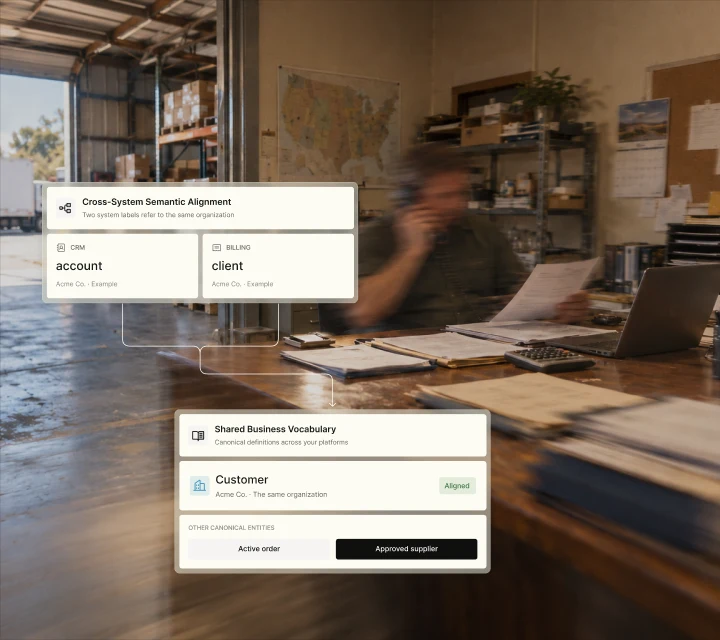
Shared Business Vocabulary
Cross-System Semantic Alignment. Two system labels refer to the same organization. CRM. account. Acme Co. · Example. BILLING. client. Acme Co. · Example. Shared Business Vocabulary. Canonical definitions across your platforms. Customer. Acme Co. · The same organization. Aligned. OTHER CANONICAL ENTITIES. Active order. Approved supplier

Graph-Connected Operational Facts

Live Knowledge Graph

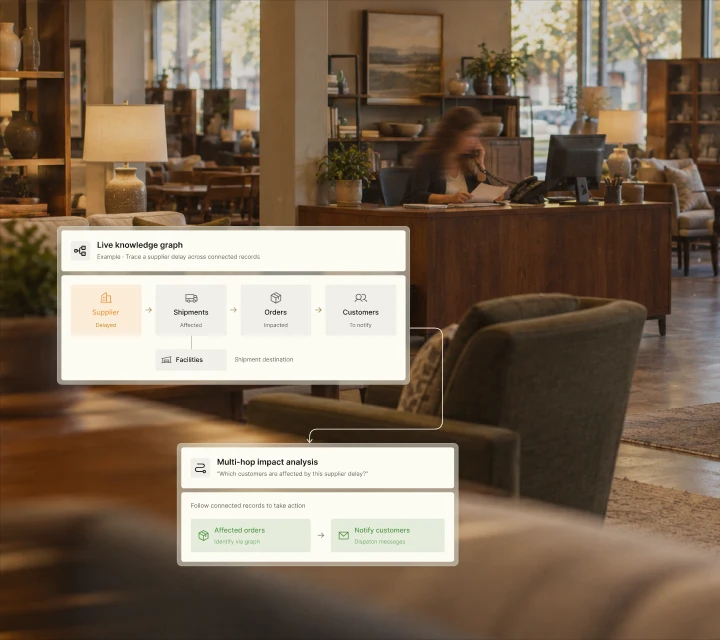
Connects customers, orders, shipments, facilities, and suppliers in a live knowledge graph.

Multi-Hop Impact Analysis

When an operator asks “Which customers are affected by this supplier delay?”, agents follow multi-hop graph edges to instantly identify impacted orders and dispatch communications.

Graph-Connected Operational Facts
Live knowledge graph. Example · Trace a supplier delay across connected records. Supplier. Delayed. →. Shipments. Affected. →. Orders. Impacted. →. Customers. To notify. Facilities. Shipment destination. Multi-hop impact analysis. “Which customers are affected by this supplier delay?”. Follow connected records to take action. Affected orders. Identify via graph. →. Notify customers. Dispatch messages

Entity Resolution & Record Deduplication

Unified Records

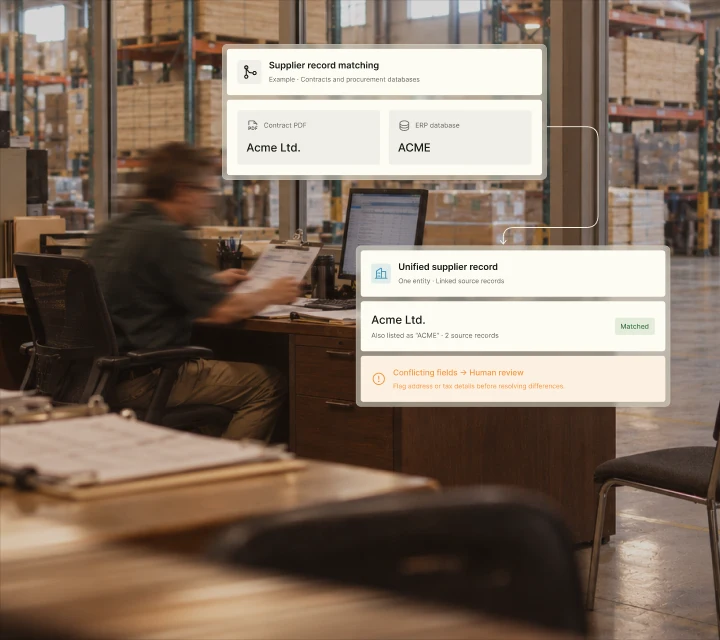
Unifies scattered records across contracts, procurement systems, and databases.

Supplier Record Matching

Links a supplier listed as “Acme Ltd.” in a contract PDF with “ACME” in an ERP purchasing database, while automatically flagging conflicting address or tax details for human review.

Entity Resolution & Record Deduplication
Supplier record matching. Example · Contracts and procurement databases. Contract PDF. Acme Ltd.. ERP database. ACME. Unified supplier record. One entity · Linked source records. Acme Ltd.. Also listed as “ACME” · 2 source records. Matched. Conflicting fields → Human review. Flag address or tax details before resolving differences.

Explicit Business Rules & Constraints

Constraint Validation

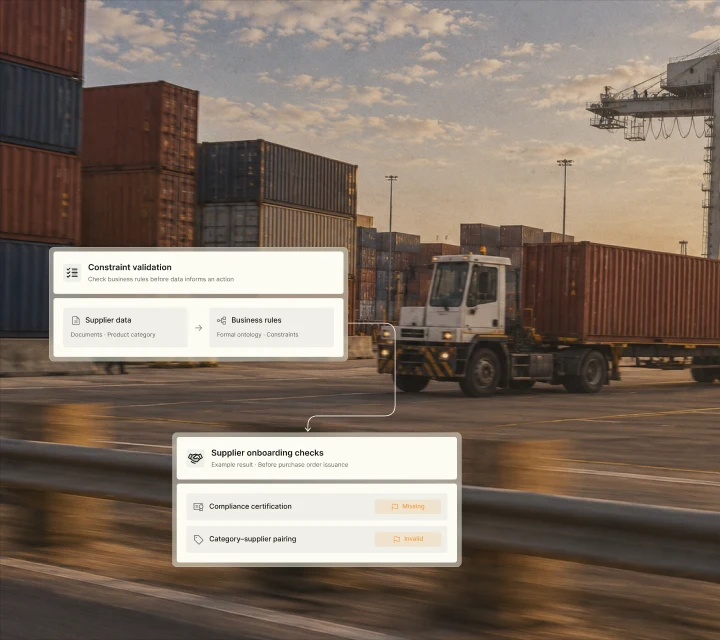
Uses formal ontology definitions and constraint validation before data informs an action.

Supplier Onboarding Checks

In a supplier onboarding workflow, Pine flags missing compliance certifications or invalid category-supplier pairings before issuing purchase orders.

Explicit Business Rules & Constraints
Constraint validation. Check business rules before data informs an action. Supplier data. Documents · Product category. →. Business rules. Formal ontology · Constraints. Supplier onboarding checks. Example result · Before purchase order issuance. Compliance certification. Missing. Category–supplier pairing. Invalid

Relational Reasoning for Decision Support

Facts & Business Rules

Combines factual records with explicit business rules to support high-stakes decisions.

Loan Eligibility Evaluation

A commercial lending workflow connects income verifications, credit history, and regulatory eligibility criteria to evaluate which loan conditions an application satisfies.

Relational Reasoning for Decision Support
Facts + business rules. Linked inputs for commercial lending decisions. FACTUAL RECORDS. Income verification. Credit history. +. BUSINESS RULES. Lending policy. Regulatory criteria. Loan eligibility evaluation. Illustrative application · Condition-by-condition. Income & credit requirements. →. Satisfied. Regulatory eligibility. →. To verify. Decision support for the lending team.

Evidence Traceability & Source Citation

Trace Facts to Sources

Traces every extracted fact back to its source document, database row, or communication timestamp.

Inspect Supporting Evidence

When an agent reports a contract's payment terms, teams can click to inspect the exact clause and page supporting the answer.

Evidence Traceability & Source Citation
Answer with citation. Illustrative example · Contract payment terms. PAYMENT TERMS. Due within 30 days of invoice receipt.. [1] Sample contract.pdf · p. 4. Inspect source. Document. Database row. Message timestamp. Source evidence. Sample contract.pdf · Page 4. 3.2 Payment terms. “Invoices are payable within 30 days. of receipt.”. [1] Exact clause supporting the reported fact

Cross-Agent Knowledge Reusability

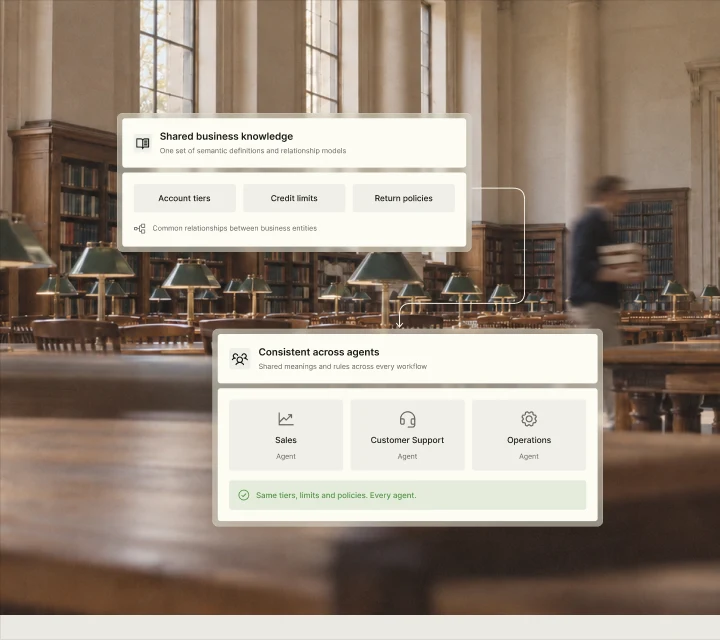
Shared Semantic Definitions

Empowers Sales, Customer Support, and Operations agents with the identical semantic definitions and relationship models.

Consistent Interpretation

Every agent interprets account tiers, credit limits, and return policies consistently across workflows.

Cross-Agent Knowledge Reusability
Shared business knowledge. One set of semantic definitions and relationship models. Account tiers. Credit limits. Return policies. Common relationships between business entities. Consistent across agents. Shared meanings and rules across every workflow. Sales. Agent. Customer Support. Agent. Operations. Agent. Same tiers, limits and policies. Every agent.

Ready to deploy an autonomous AI workforceacross your enterprise?

Experience carrier-grade voice agents, cloud computers, deterministic workflows, and connected business knowledge.